Iheoma J. Uzomba
I
Father
Father’s Love
“‘The fire and wood are here,’ Isaac said,
‘but where is the lamb?’”
Genesis 22:7
Love is a fifty-three-year-old keloid on my father’s chin. It bobs
as he swallows another ball of fufu, throws his legs apart & laughs,
laughs in big syllables. Ha! Ha! The scar, still fresh from the time
as a boy, he stole his father’s snuffbox, hid in the corpse of dusk
to smoke its minty powder, mistake the burn in his throat for
the making of a man. His father found him, as God finds the lamb,
trembling & near-ready for offering. One swing of the pestle split
his jaw and the night became a gathering of teeth. This is his first
love story: a violent rite of passage where the father invents a son
to prove his place: Abraham luring Isaac to Moriah as meat for
his ego, to let God know he is man enough to unmake a life, to
possess a knife and draw blood from his offspring. The choreography
of affect comes plain in a father dressing his son before the altar,
ready to relinquish responsibility for the greater price of earning
a name, a death inherited. I touch my father’s chin and feel the
solid mass, this dark swelling of fatherly love. I ask if it still hurts.
he laughs, laughs in big syllables, says oh, it was so long ago.
Hands
The voice is Jacob’s voice, but the hands are the hands of Esau.
— Genesis 27:22
My father’s hands are shovel-like. Wide black palms with calluses
and grease caked into fingernails. Nicks and cuts like hieroglyphs
written against the wall of his skin. The texture of palms, a three-day
old scoop of amala congealed to rubbery mass. Fingers, brittle and
stout like weather-beaten furniture. The geography of my father’s
hand is a warring nation losing its borders to knife cuts & gunshot
wounds, small moments of pathos. Sometimes, we play this game
where I count the number of scars on his handsand subtract
his age from the number. The answer is always in the negative.
Isaac reached for his son in the dark and blessed the wrong boy
until he felt hands. Hands. I recognize my father by his hands,
rough hands that refuse when I reach for them. The arithmetic
of history glazing in year-old scars. Hands that lifted weights &
unscrewed faulty car tyres. Hands that split wood and nailed
roofs. Hands that clutched rakes and rods, that chiseled cement
through leaking walls. Hands always for burdensome work.
My father once reached for my chin as fathers on TVs do their kids
about to leave home for school, and his hands froze midway.
The economy of touch, a love language undecipherable.
Hands that never knew affection this way. My hands are not good,
he hissed, then pressed two fifty naira notes into my palm.
God, the Father
We look at the world once, in childhood. The rest is memory.
– Louise Glück
I recognize my father by the scars on his elbow like a line of ants, some from the war, others from
the bites I instilled
like little kisses, a love language. you must believe love is love even when you do not see it, even
when the man sucking
phlegm from your nose, gurgling it behind his throat to spit out the mass in a thud turns his
back to call you bastard
& in a bid to revive the corpse of memory, I watch my body sift through time like linens, my
father lulling me to sleep
with stories of the war. like the time his mother dug red earth and buried him in a hole for three
days, the whole time
he swallowed back sneezes & prayed that God would reverse his asthma like an ancestral curse,
let the cup pass over him
so living is mere practice without consequence. or the time he grew leaner than impatience,
leaner than any of the cows
in pharoah’s dream, & his mother, for want of breastmilk, fed him the salt in fresh fish, so that
his tastebuds died to spice
for good. or the time he lay underneath potato stalks with other boys hiding from the rain of
bullets, the gun’s mouth
& the other men making soldiers of little boys. once, he knocked a tooth off and another and
another, trying to escape
the fire. & loss multiplies in other places like the cavities in a good night and take care and the
absence that fills the air
in place of an i love you too. oh my father, my father, my father, your love is as unruly as your
hairline, refusing to recede
but thinning nonetheless. I miss your answers to my prayers, your hairy arms of forgiveness,
your elbow,
a boomerang bringing my childhood back in nooks, those playful bites that became relics for
your skin to carry.
I miss even your absence as I adjust my disappointment, like sleeves, to the tempo of the night,
hoping whatever
brings you home is not the pulse of alcohol, not lust for some woman’s body, not death again,
please.
Boyhood & the Texture of Loss
& oh, how we loved to dance, our fathers’
makossa recalling boyhoods, hats spilling
twenty-naira notes: a boy biting fortune
& his tongue as he mouths i love you,
as he mouths please, stay. Memories of sugarcane
chewed white, mango seeds gnawed clean of yellow.
Football afternoons with twisted knees,
ankles, the chorus of mothers yelling:
our only son, our only life. Our only father
was a boy too, strutting Owerri’s highways,
trousers & hopes sagged, wounds
fresh from street fights,
a mouth rid with sores & sorries.
Our only son was our only brother was our only father:
a jawful of cuts from shaving
anxieties down like beards.
He reaches the cusp
where dawn becomes a swelling.
He disappears. The curse
comes running backward—toward
the beginning of the man,
the metaphor of his boyhood.
This yawn of a man coming awake
from behind a mirror to look upon himself
& see a nothing so robust, so six feet tall,
they call him father.
Footnotes to Forefathers and the Arrow at Full Draw
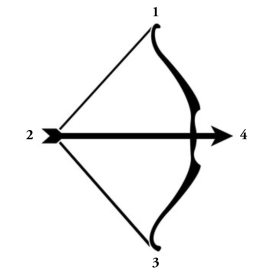
1 in the beginning was the war & the war was with us & the war was us. My grandmother knows the beginning is yarn that loops and loops and loops; the beginning never ends. This is why at the top limb of the bow, my grandfather’s back is the sun slouched beneath the sky of a white man’s whip. The welts on his skin grew into an extension wider than my family’s tree. Do you know what it means when a black man dreams to be the white beam at the end of the tunnel? One day, my grandfather climbed to the highest coconut tree for a leap and became the first ever gymnast to win a suicide medal in my family name.
2 a father’s shame is the base of every triangle, the root of every family tree. My father hides the truth of our lineage in every glass of beer, swallowing the light of a new language to drown the evil of our past. To be Nigerian is bad enough, to be Igbo is a sin.
3 & I am the bowstring, clinched to both sides of the bow by the history of forefathers, suturing the graves of two generations in my mouth. In every poem, my body is a vile thing where I exorcise the god in my bones with morphine. I too have shelved shame long enough to envy the moon and its naked core, piercing through every dark street with ease. I too have stayed silent with the skeletons long enough to hear bliss whispering from without the cupboard. Do you know what it means to be ocean in a wine-glass? When I walk into a room, my body becomes a blur & the first thing a stranger fears is my Nigerian hue of black skin. They do not say killer, drug-addict, swindler out loud but they clutch their purses a little tighter and stiffen into the background of my shame.
4 the history behind me has ruined me. My shame propels me to run naturally. I am at once the arrowhead, seeking home in a man’s chest, seeking a means to my end. The beginning would not stop beginning again.
II
Mother
God, the Mother
scripture says a fourteen-year-old virgin pushed forth the messiah through her canals,
split thighs
tearing the walls of heaven in two. the miracle of salvation, a maternal pun undone
at midnight.
my mother unties the knot of history with her gele as she settles into the armchair, fingers
the remote
& wills the television come alive to stories of women taking sacrifice to mean slipping wads
of notes
in their husbands’ back pockets and godding masculine alter egos, to mean moaning even
when they
never enjoyed the sex, to mean swallowing their tongues & contouring shame in the swell of
cheekbones.
she kills the light in her eyes and tells me to do the same. this is no way to live, she says &
memory
comes sober with the genealogy of women holding shame down to next-of-kins like necklaces
exchanged in
places only women know to go like kitchen stalls and girls’ bathrooms where everything from
menstrual health
to lazy sex is discussed, hauled over pots of soup or moist bathroom stalls with faces simmering
over vomit
in toilet bowls. did you know that women are three times more likely to be misdiagnosed
because
no one would believe her pain isn’t make-believe too, a doll’s fantasy, a dramatic lament,
a threnody
exaggerated. truly, my mother says, she dies every day learning to make her resurrection at least
believable.
Girlhood & the Texture of Static
time would launch towards us
to the many times we’ve let tap water
sail through our open mouths
bent sideways by the weight of thirst.
but even this does not let us
sore this girlhood custom
of trading liquid
one mouth to the other,
until our mothers are screaming
from halved windows:
you don’t drink that way!
there’s no perfect way to sin
than becoming other.
so tonight, we do not count the stars
and thumb our names into the sand
while this crust of darkness encircles us.
we have grown now
& this is what time brings:
unscrewing our favorite cocktail in the dark
with music high over the sideboard
and our lovers’ lips clung to ours
bodies upturned, sleek and wet.
each breath exploding, a short victory earned
to how long we may share this freedom.
Program to compute the Mass of Anguish in every Confessional Girl Poem with Series up to n terms
for i = girl; rainbow in monochrome; misfortune clotted; lone rose petal seeped clean of red
i have reached for heaven with my hipbone in hand
to crack God’s skull & dislodge the arms of time from their ball-sockets, return to earth
a fallen angel. i would delilah my way through the fire & make it unscathed.
a boy seized my fruits in his palms & tasted themeven before i learnt to call them breasts.
i grew up kissing stray boys beneath mango trees,
letting the steam of night-time sheathe our faces;
took my undies off one time to show a boy the flower
between my thighs & he laughed at it afterwards,
called it a snail.
i swear, i never knew someone could become symbol, a part,
like the gills not the fish, the hoofs not the cow
until i became a mouth, all of me, disappearing
into the space beneath a man’s belt hook.
& often my belly is a firehouse; my arteries, the chimneys
busting into a hundred pathways with smoke.
i yell at the moon for mercy.
i did not choose this pain of a thousand shrapnel
stinging the god behind the walls of my uterus.
where ache > body
// print results
for (there is no way to compute anguish in zeros and ones)
at the end of every tunnel, there is more darkness
& the deceit of illusion.
every new ache awakens the stream of aches pelting down
memory lane to the first time a nurse punched two holes
in my ears to announce my girlhood to the world.
the day i learnt menstruation was not a game the big girls
played at night, the sun dodged my face like a ball,
as though the knowledge itself was curse,
enough to betray an entire race out of Eden.
where the square root of girl = grandmother, mother,
wife, aunt, sister
// print results
for (in every confessional girl poem, my body spills across the page
& i know the knot of heat in my throat is a cantaloupe
with the ghosts of women before me, warming to God for wreak & revenge).
Ache is a Feminine Word
i have spited the french for christening each word
with gender. tell me how you knock off the nouns
lipsticked & pretty from the ones that bolt the sky
& wilt the roses. show me the bridge that leads a word
to its inflection and watch me set its gut on fire.
there shall be no tow-truck from painless to painful.
every other day, the word push evokes the image
of my mother knock-kneed, thighs spread before
a midwife & the curse of nightfall. push! you can
make it: your baby is almost here. my mother pushed
& pushed the storm in her womb into a newborn.
i was born drenched, weather-beaten & she,
unable to be born anew, drowned in my place.
to be womaned is to learn of new aches. i
swear, when the monthly spirit stirs the pool
in my belly, i call out to my mother’s ghost
by the sea. always, she knows the voice of her own.
she sings forth to rescue my soul & bids me
scream into the sky—perhaps, all that blue shimmer
would hold my aches, the way it holds the stars in place.
The Kitchen as Slaughterhouse where Crucifixion is just another Permutation of Loss
Today, the messiah lays life down before a kitchen knife
& i see God in the yolk beaten into a pan, whisked
till angry-yellow, an evening sun. There is glory in the moment
murder segues into martyrdom, as the knife chops with devotion,
as blood spills & the kettle whistles in prayer, as the fire
throws open its lips to wring & swallow.
When i stir the Banga soup and it sours, i realize salvation impairs the soul too.
When the buttermilk spoils the dish, i learn how lactose-intolerant grief is.
All my years, i have never seen anything walk into the kitchen
& make it out alive—not the hen, not the lamb, not my mother.